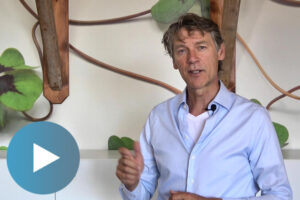
Ruben ten Asbroek (graduate student) on innovation processes:
‘The rise of Agile working, Lean Startup and Design Thinking has had a great impact on the practice of innovation management. Does this mean that Stage-Gate is obsolete? To find out, as a graduate student I first studied the theory of these processes. Then I analyzed 150 BEACON innovation projects for the methodologies used. With the goal of identifying which approach works best for different types of innovation projects. My conclusion is that the Stage-Gate process is still relevant as the backbone of the process. The other methodologies each have a unique value. When deployed at the right times, you innovate faster and with more focus on adding value for the customer.’
‘Most companies innovate according to the Stage-Gate process: at the beginning of the process you think very carefully about what the final product should be, what the customer wants and how you can make that technically possible. So the end goal of the innovation is more or less fixed right at the beginning. Then you make a schedule, after which you work in a straight line toward the final product.’
‘The core of Stage-Gate is that you go through several stages with go/no-go moments. For each gate, you have to have certain things clear, commercially, technically and supply-wise. Based on that, you can decide to move forward.
This process has several important advantages:
- At all stages, you have a complete overview of where you are and what remains to be done.
- At each “gate,” you check the extent to which progress is in line with the plan. You can’t move forward until everything is approved. In this way, the process guarantees quality.
- The process helps keep all disciplines on track, so that no one falls behind.
- The overview makes it easy to make decisions and communicate to all stakeholders.’
‘There are disadvantages, too. The Stage-Gate process is regularly perceived as inflexible, bureaucratic and slow, so you can’t respond adequately to changing circumstances. For example, you may end up making something that doesn’t mesh well with what the customer wants after all. To overcome these drawbacks, I developed a model for BEACON that integrates the relevant aspects of Agile, Lean Startup and Design Thinking into Stage-Gate. Each methodology contributes uniquely to the overall process.’
‘The relevance of Lean Startup lies at the beginning of the process. As a starting point, you have a product idea and a business model. The method is very hands-on. You immediately start testing with customers whether the underlying hypotheses are correct. For this, you use a minimal viable product (MVP). So if you want to make a new app that navigates, an underlying hypothesis is: the target audience would like to navigate using an app. You start validating your hypotheses in increments, adjusting your business model or product as needed. You do this until you find a desirable product with a scalable business model.’
‘Design Thinking is a method that also plays a role at the beginning of the process and puts the end user at the center. You start looking: what is the user’s problem? And what is the added value of your product for the consumer? The method has several ways to arrive at a good solution that suits the consumer. Design thinking is a welcome addition within the innovation process because of its focus on the user and their needs.’
‘Agile is a method in which you work iteratively and incrementally, with a lot of ownership by the team. For example, with clear task agreements in frequent structured meetings. Scrum is also part of agile working. This is reflected in all phases of the innovation process.’
‘Many companies have defined their own Stage-Gate model with stages, gates and deliverables. And some companies even have fixed templates for each deliverable. It is understandable that managers want certainty and uniformity, but the downside is that the system is perceived as rigid and bureaucratic. Lean principles help avoid this. The method says: all activities that do not directly contribute to creating value for your end customer should be eliminated. It is an art for project managers to always find the right balance between certainty and dynamism.
The new model I developed for BEACON still uses Stage-Gate as the backbone of the innovation process. The integration of the various new methodologies has enriched the process. This results in a fast and flexible working method with a focus on the customer and the practice.’
I would love to have a conversation with innovation managers and project managers to hear if this new model fits your daily innovation practice. Would you like to know more about the model and would you like to participate? Please contact ruben.tenasbroek@beacon.nl.
Back to overview